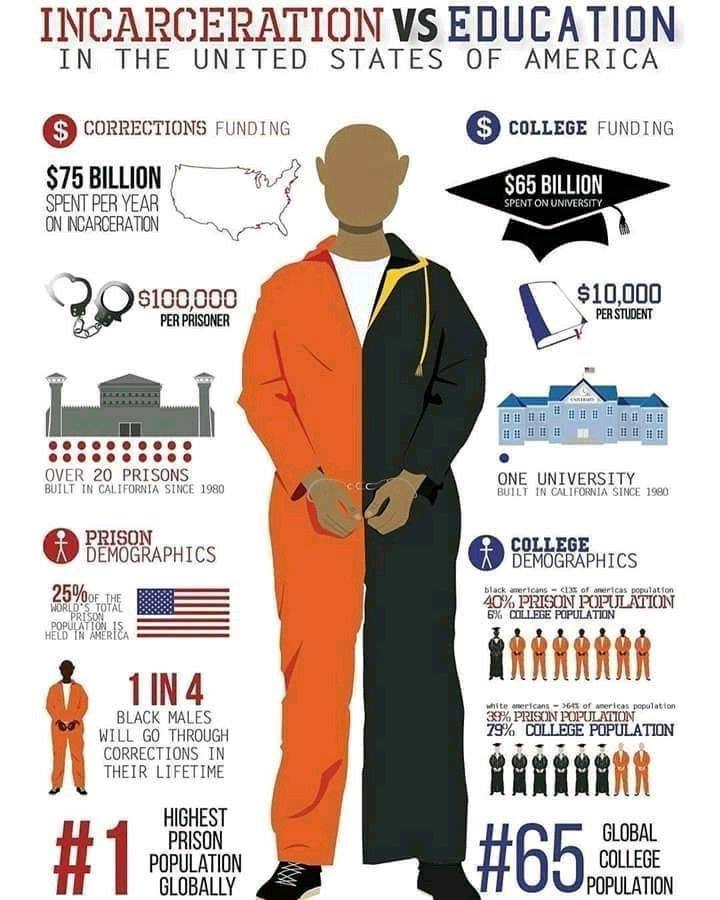
Prisons are seen as the mode in which crime and punishment are handled, but what really goes on? Does prison actually make us safer? The simple answer is no. Prisons are intended to reduce crime, rehabilitate offenders, and increase safety. As Desmond and Emirbayer write, “Inmates who participate in prison education or treatment programs might be rehabilitated, and turn away from crime after they are released. Prisons might simply incapacitate offenders, locking them away to prevent crime in society. Finally, prisons might deter those who would commit a crime were it not for the treatment of incarceration” (Desmond and Emirbayer 220). However, none of that really happens. Prisons do not and have never rehabilitated people. Statistically, prisons actually lead to more crime. Prisons do not reduce crime by incapacitating offenders because locking up first offenders and drug dealers do not reduce crime. Finally, most people do not take into account the consequences when committing a crime. It is obvious that prisons do not function in the way we think they do. Prisons are ineffective at reducing crime and increasing safety, instead, they negatively harm individuals’ opportunities to participate in society.
In order to effectively end the STPP, policies need to be put in place banning zero-tolerance initiatives and exclusionary discipline. By doing this, students will not lose time in school or be punished for non-harmful social behavior and academic records. According to The Southern Coalition for Social Justice, “A diverse school staff representative of the student body is one important way to help equalize opportunities for students of color. A recent study revealed that low-income Black students in North Carolina who had at least one Black teacher in elementary school were significantly more likely to graduate high school and consider attending college” (Southern Coalition). Another way to combat juvenile incarceration is the removal of police officers from school campuses. Relocating funds to counselors, social workers, and mental health professionals can help individualize the needs of every student and tackle student behaviors from the root.
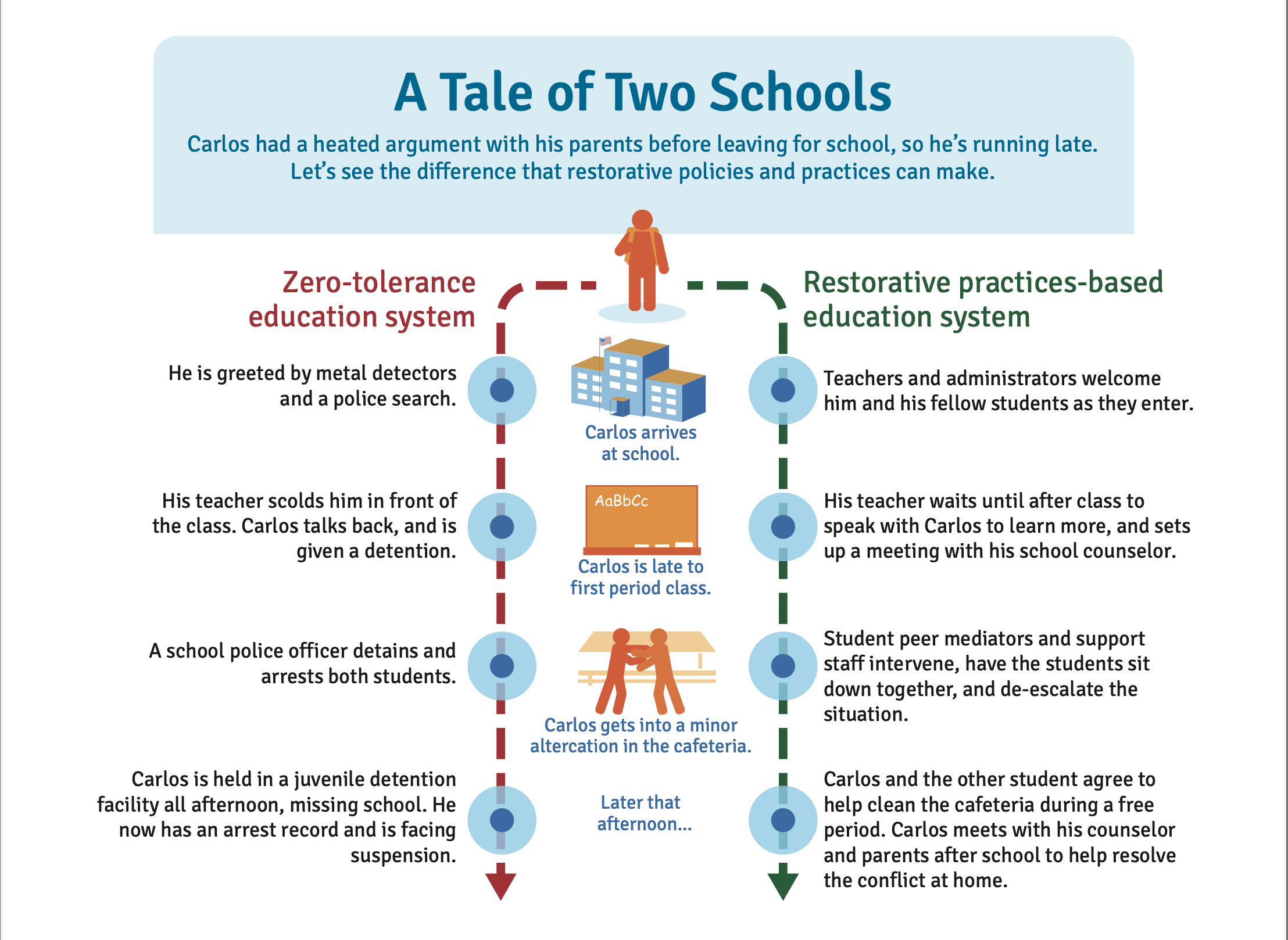
Implementing restorative justice in schools is an effective way to address student and teacher relationships and responses to discipline. According to The National Education Association, these practices include but are not limited to, “Addressing and discussing the needs of the school community, building healthy relationships between educators and students, resolving conflict and holding individuals and groups accountable, reducing, preventing, and improving harmful behavior, and repairing harm and restoring positive relationships.” Some of the ways restorative practices could be implemented are through community service initiatives, peer juries for determining punishment and peer mediation. The focus on the mechanisms that cause behavioral or academic issues positively affects students and finds solutions for long-term improvements.
Below is a graph of what restorative justice would look like in school compared to a zero-tolerance policy.
http://schottfoundation.org/sites/default/files/restorative-practices-guide.pdf
